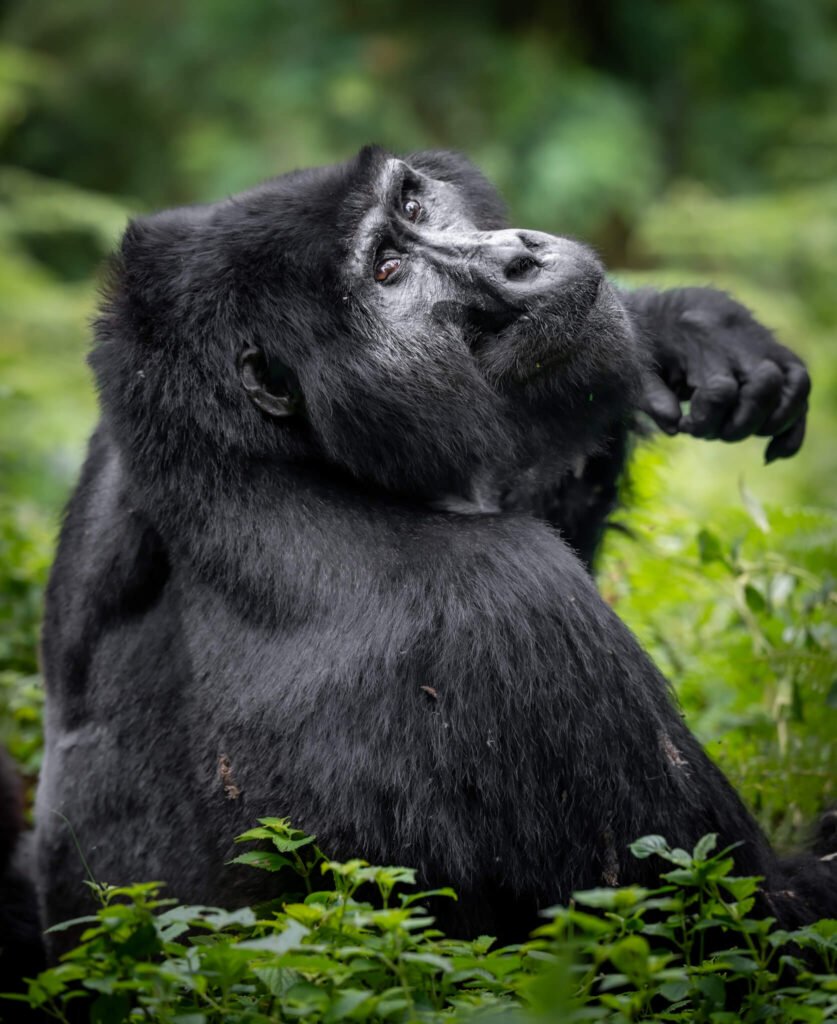

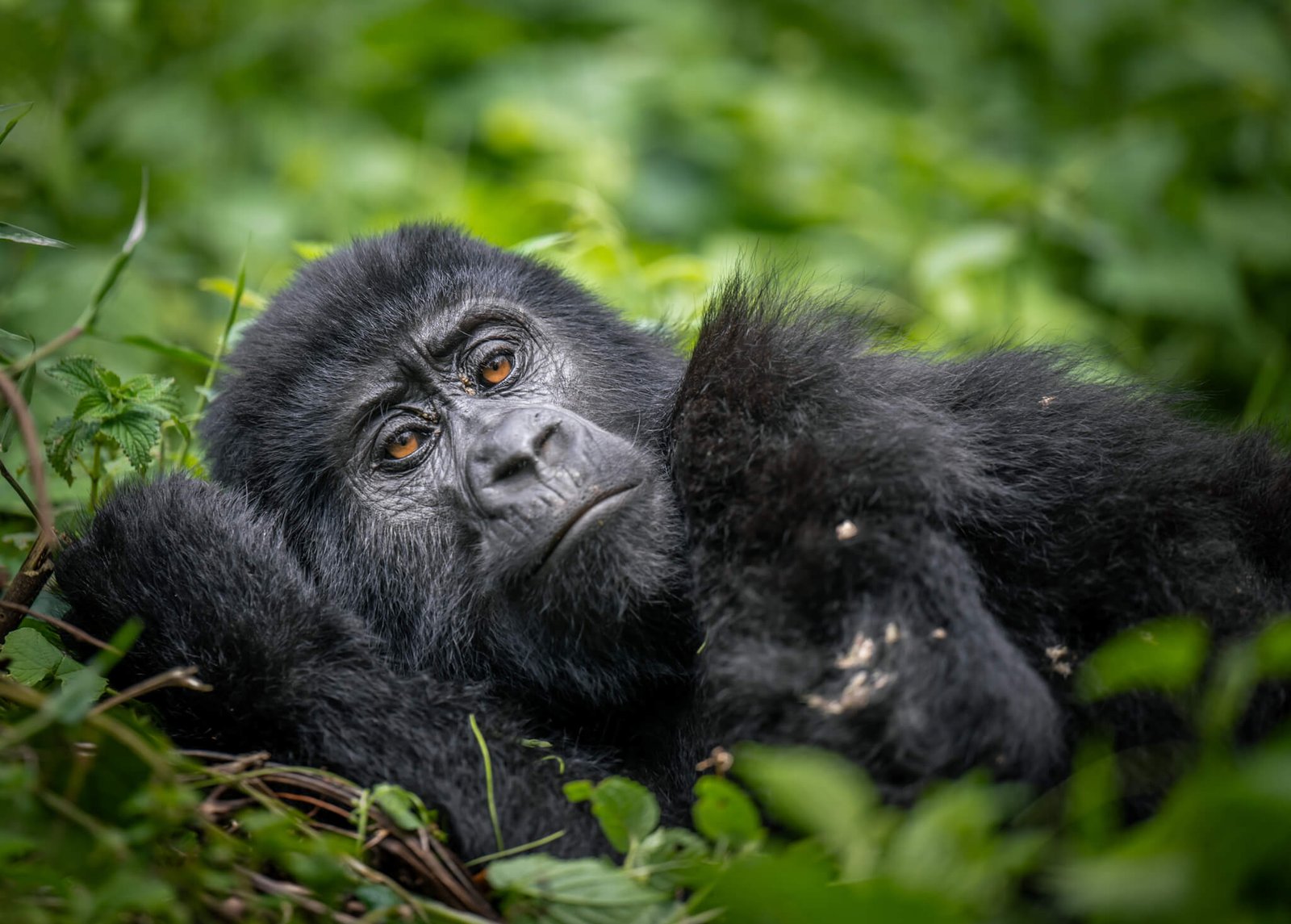
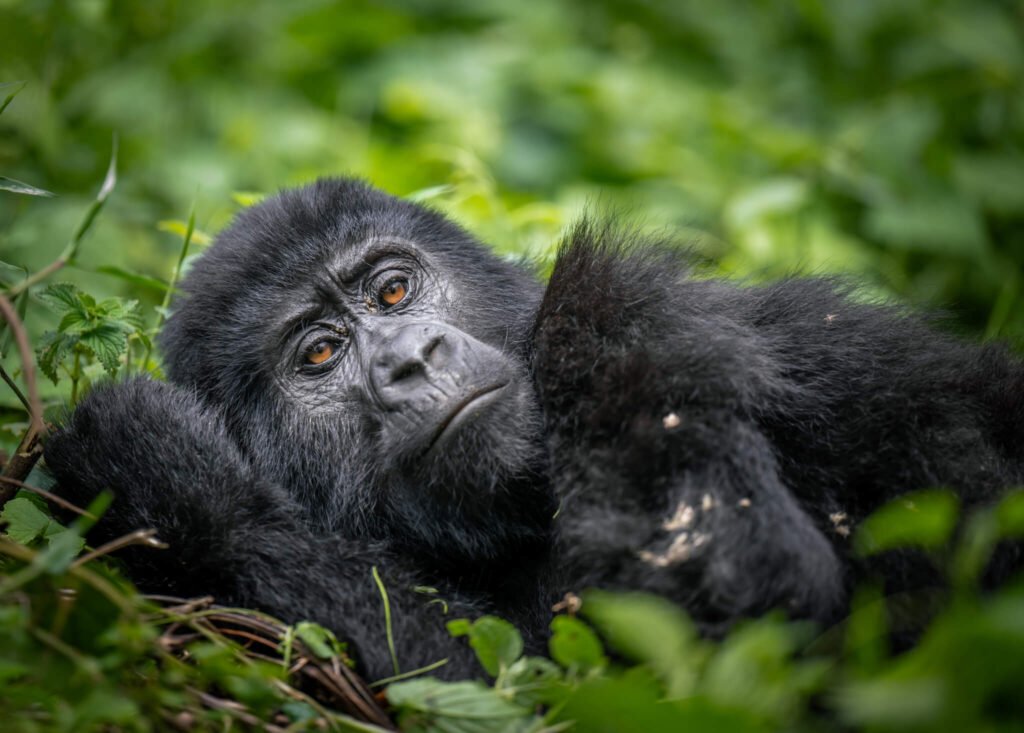
WHY GORILLAS?
Ever since I started taking my first steps in wildlife photography, I knew there was one animal I wanted to see more than all others – the mountain gorilla. At the time it seemed like something far away, almost unattainable. Bwindi was just a name on a map, a point deep in central Africa, a place that is not talked about very often, but when it is, it is spoken of with great respect. Still, I had the hope that such an encounter would happen, not as a tourist adventure, but as a professional challenge. I simply wanted to photograph them.
BWINDI IMPENETRABLE FOREST — A FOREST THAT DICTATES THE PACE
Bwindi Impenetrable Forest lives up to its name from the first moment you step into it. This is not a forest you can just “walk” through. This is the terrain that dictates how you move — slow, careful, concentrated. Dense vegetation, changing weather, fog that appears out of nowhere, slippery ground and steep climbs create an environment that tests both physical and mental endurance. For some, trekking to the gorillas can be a couple of hours of hiking on more accessible terrain, while for others it can be 5,6 hours of crawling through thick vegetation with fog, rain and mud. It all depends on where the gorillas are at the given moment and which gorilla family you will be assigned.
ARRIVAL AT THE STARTING POINT
Immediately after arriving at the place from where we will start our search for gorillas, we waited for the rangers to assign us a family. We got the Christmas family, which currently has 9 members, including 3 females and three-year-old infants (male and female). The leader of this family is a silverback gorilla named Christmas, who got his name because he was born on Christmas Day. After we were assigned a family, we were given hiking poles, and those who wanted could also take additional equipment such as gaiters or raincoats. A dance group waited for us outside and wished us luck with a traditional dance. The search has begun.
Right at the start we entered a dense fog, and shortly after that the ascent began. Emerging from the fog, locals from the area passed by us – some carrying large woven baskets on their heads, others with bundles of branches tied around their waists, while the younger ones walked past with backpacks on their backs, most likely on their way to the local school. After about an hour of hiking, a view opened up of a small village through which we had to pass. As we entered the village, I noticed the locals stepping out of their small houses and watching us with curiosity, while the children followed our every move with their eyes, hoping to receive a sweet, which, of course, they eventually did. Throughout the walk, the ranger educated us on how to behave in the presence of gorillas. He told us that we must not make noise, carry food, or touch the gorillas, as this could be fatal.
WAITING GAME – TEN MINUTES THAT FELT LIKE AN ETERNITY
After a long ascent, the ranger raised his hand and quietly signaled for us to stop. He looked at me and asked, “Are you excited?” I felt as if the entire journey up to that moment had lodged itself in my throat. He told us we need to wait about ten minutes because the gorillas were moving toward us. Those ten minutes felt like an eternity, although in reality we ended up waiting a good half hour, if not more. One of the rangers was unable to make contact with the trackers following our gorilla family via radio, so he went off to look for them. The silence and calm of the forest, where only insects and the occasional snap of twigs can be heard, force you to think about everything, about the fatigue, about your motivations, about the privilege of having the opportunity to be there. After what felt like an eternity, we spotted our ranger returning. He joked that the gorillas might have fallen asleep and that we wouldn’t see them. He was laughing, of course, fully aware of my impatience. And then he uttered the sentence that set off an avalanche of emotions:
“Nikola, are you ready?”
I was — and yet I wasn’t. Technically yes I was ready, but emotionally it felt as if I had returned to my very first day in nature with a camera. The thought that I had been waiting for this moment for a full year, thinking about it almost every day, kept running through my mind. This was really happening! Just five minutes later, we were near the spot where the trackers had located our gorilla family. We put medical face masks on our faces, which are mandatory, since gorillas and humans share 99% of their DNA and it is very easy for diseases to be transmitted either from us to them or from them to us. At that location, we also left our backpacks, walking sticks, water, and food, and slowly made our way toward the gorillas.
FIRST ENCOUNTER WITH MOUNTAIN GORILLAS
And then everything went silent.
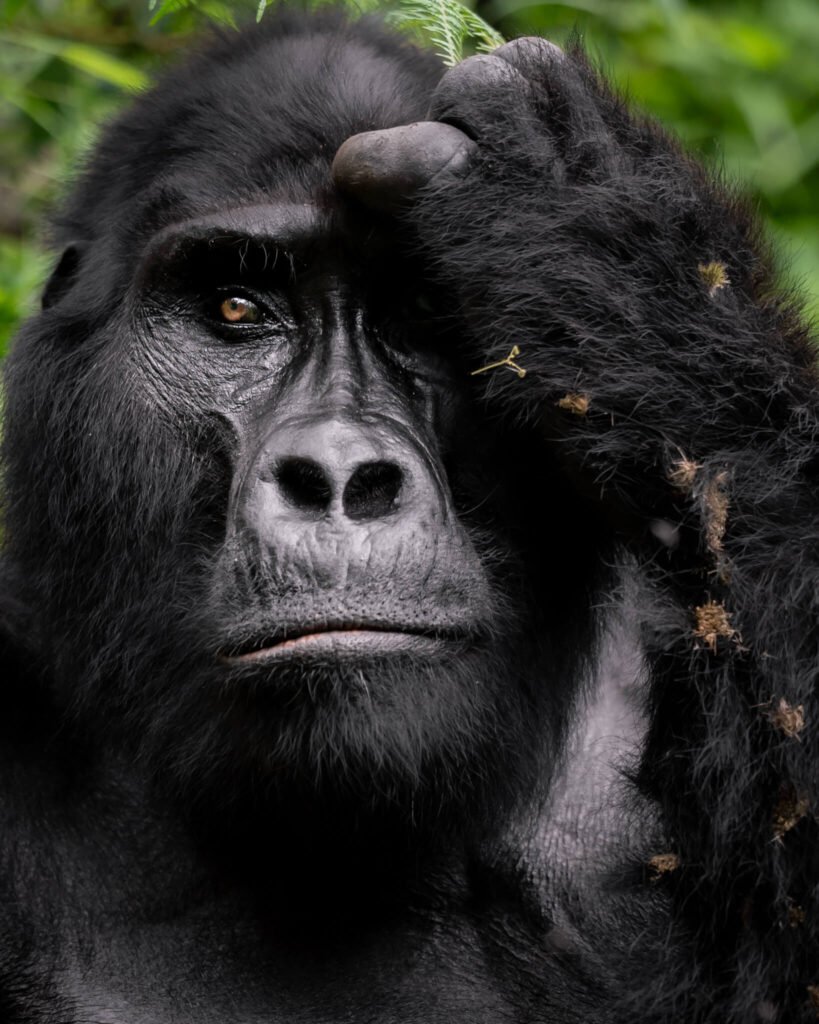
The first thing I saw were two furry “balls.” They were infants, lying in the grass and nibbling on it. I don’t remember exactly the first frame I captured, but I remember the feeling perfectly… it was incredible! A gaze coming from an animal that understands the world around it far more deeply than we assume. There is no chaos, no sudden movements. Their behavioral structure is quiet, yet clear. What touched me the most were the looks in the eyes of these incredibly intelligent beings. Eye contact was the most powerful moment, something that no documentary, no book, can ever describe.
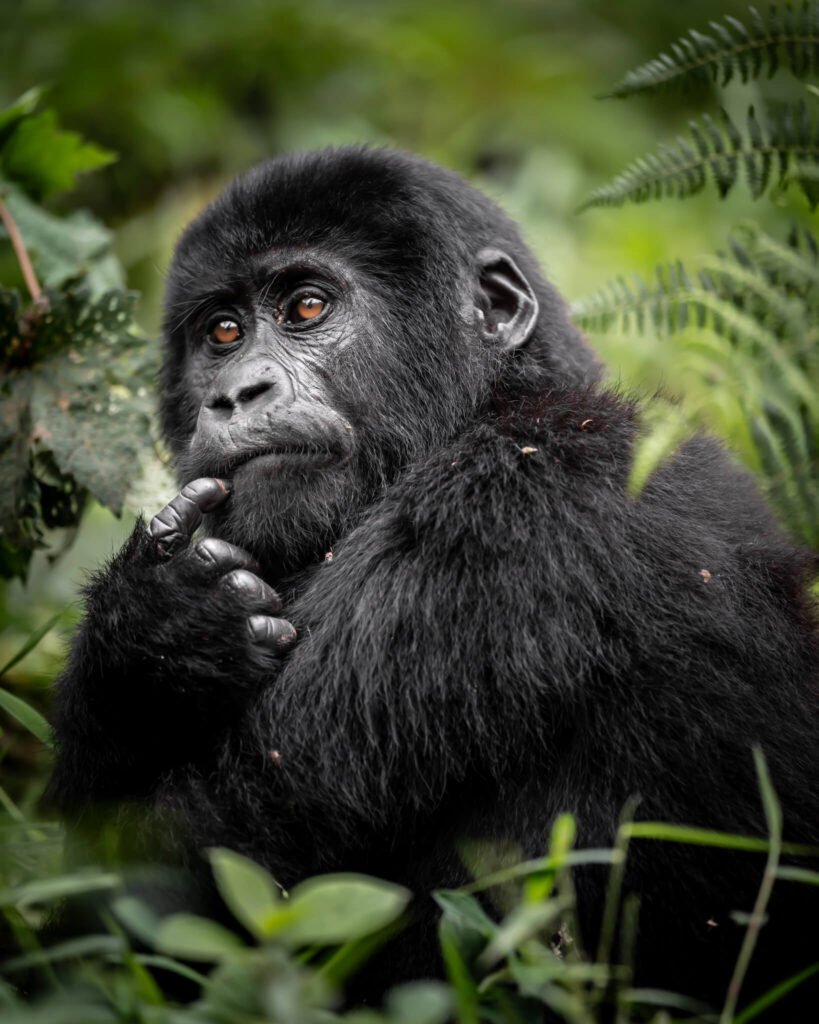
Mountain gorillas are among the rarest animals in the world, with fewer than 1,100 individuals remaining today, and they live only in the mountain forests of Rwanda, Uganda, and the DRC. Although they look strong and intimidating, in the wild they are surprisingly calm and gentle animals that avoid conflict. The males who lead a group are recognized by their characteristic silver backs, which is why they are called “silverbacks,” and their strength can match that of several adult humans combined. Interestingly, mountain gorillas have fingerprints almost identical to humans, they don’t drink water directly from streams but obtain it from plants, and every night they build a new “nest” of branches and leaves to sleep in. Young gorillas are extremely playful and behave like human children, wrestling, jumping, and exploring the world around them. However, due to their genetic closeness to humans, they are highly susceptible to our diseases, and even a common cold can be life-threatening for them.
WILDLIFE PHOTOGRAPHY IN BWINDI FOREST – EQUIPMENT AND CHALLENGES
Photographing gorillas in the Bwindi rainforest is one of the most exciting experiences for nature lovers, but it requires careful planning and a responsible approach. Dense vegetation, changing light, and limited mobility create challenging conditions, making equipment choice crucial for capturing high-quality images. The most practical are versatile zoom lenses such as 24–70mm or 70–200mm, which allow shooting from different distances without frequently changing gear. Due to low-light conditions, it is important to use lenses with a wide aperture (f/2.8). Flash is not used because it can disturb the gorillas, so photography relies entirely on natural light. Condensation can be an issue due to temperature differences, so equipment should be kept in its bag until it acclimates to the environment. Most importantly, it is essential to follow the ranger’s guidelines and restrictions: maintain the required distance, avoid sudden movements, and do not disturb the animals’ peace. The weather here is unpredictable and we were lucky that it didn’t rain during our encounter, but a cloud did caught up with us on the way back. It is recommended to carry a raincoat both for yourself and for your camera gear. Rainfall in Bwindi Forest can be intense, and in just a few minutes, both you and your equipment can be completely soaked.
DIAN FOSSEY - THE WOMAN WHO DEDICATED HER LIFE TO GORILLAS
No story about gorillas can be told without mentioning Dian Fossey. After photographing gorillas in Uganda, I visited the Dian Fossey Museum in Rwanda. It isn’t a museum in the traditional sense; it feels more like a combination of an archive, a memorial, and a field laboratory. Original journals, equipment, photographs, and documents present her work without romanticization. She is a woman who dedicated her life entirely to gorillas, often in conditions that were brutal.
Dian Fossey is:
- the first to study the behavior of mountain gorillas in detail,
- to document their social structures,
- to fight against poaching,
- to risk her own life to protect their habitat.
Her Karisoke camp became a historic site, and her work made it possible for a stable population of mountain gorillas to exist today. Visiting the museum was a complete success, and her efforts in conserving these incredible animals somehow felt like an inspiration for my own work going forward.
A MEMORY OF MY BEGINNINGS
Standing there among the gorillas, I thought about my early days with a camera. Back then, gorillas were just an unattainable dream. But that dream motivated me, pushed me forward, and reminded me that worthwhile things don’t come easily. My encounter in Bwindi was proof that dreams can come true, you just have to believe in them.
Bwindi didn’t give me only photographs. It gave me:
- a confirmation that I chose the right path,
- an understanding of how important respect for nature truly is,
- a new perspective on my work.